
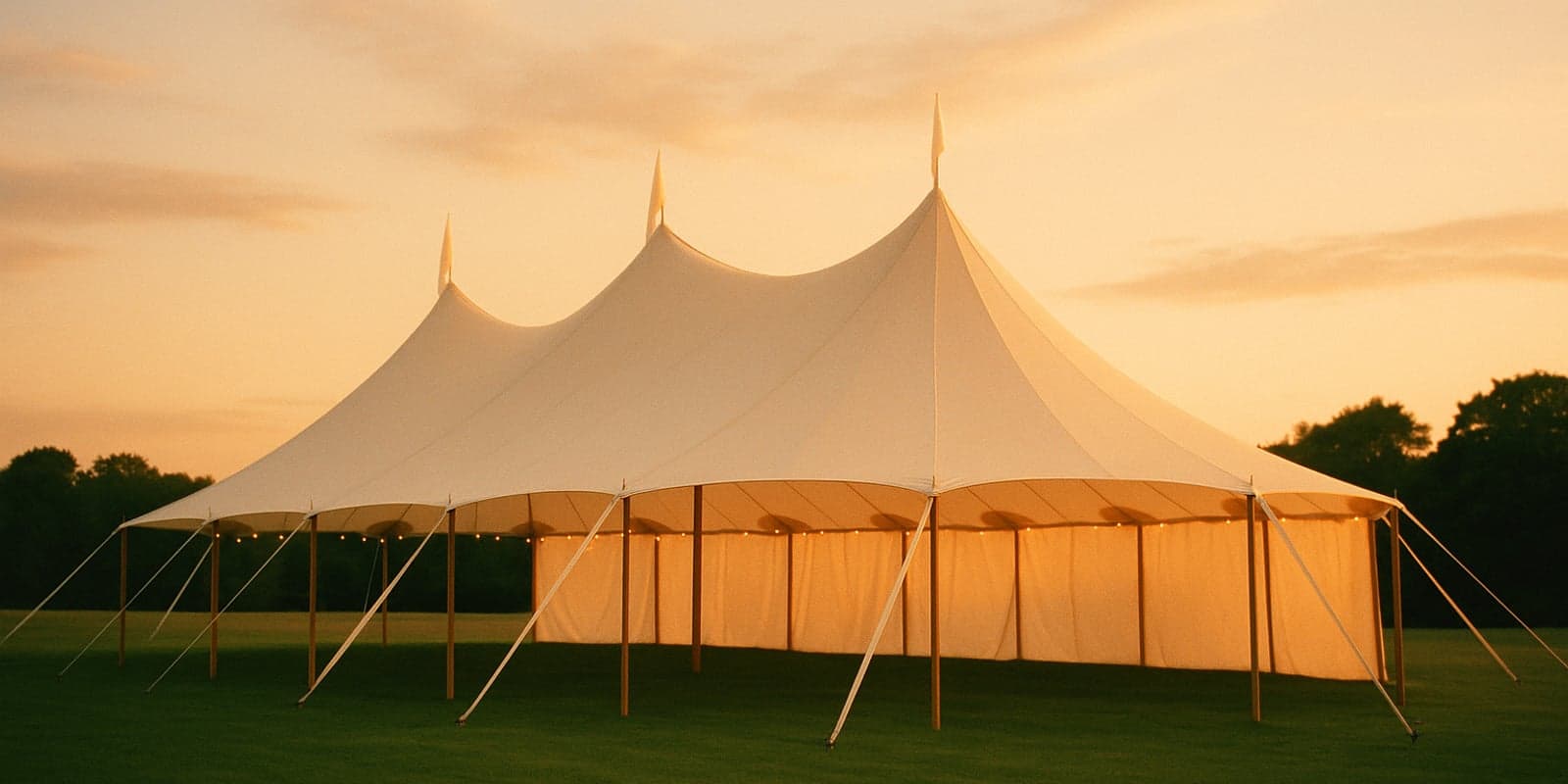
Frame tents and pole tents are the two backbone categories of event rentals. They look different, cost different, anchor different, and fail in different conditions. Roughly 65% of weddings end up with a frame tent; the remaining 35% go pole for the classic peak-roof aesthetic. Here's how to decide which one fits your event.
Side-by-side comparison
| Attribute | Frame tent | Pole tent |
|---|---|---|
| Structure | Metal or aluminum frame, no interior poles | Tall center poles + side poles, tensioned guylines |
| Look | Squared-off, modern, less dramatic | Classic peaks, the iconic wedding-tent silhouette |
| Interior obstruction | Completely open, nothing blocks the view or floor plan | Center poles impact sightlines and table layout |
| Surface requirement | Pavement, decks, grass, gravel, concrete, any surface | Grass or dirt ONLY, must be staked |
| Anchor method | Stakes (grass) or weights (pavement) | Stakes + tensioned guylines extending 8-12 ft beyond tent edge |
| Wind rating | 35-45 mph (engineer-rated for higher) | 30-40 mph typical, taller peaks act like sails |
| Setup time (20x40) | 3-4 hours for a 4-person crew | 2-3 hours, faster install when conditions are right |
| Cost premium | Baseline for comparison | 20-35% cheaper per sq ft |
| Available sizes | 10x10 up to 60x200+, modular sections can be joined | 20x20 up to 60x150, less modular |
| Sidewall compatibility | Every sidewall style attaches cleanly | Sidewalls work but fit is less tailored around center poles |
| Best for | Paved venues, complex layouts, sightline-sensitive events, wind-risk areas | Classic outdoor weddings, farm venues, open-field events, budget-conscious bookings |
When to pick a frame tent
- Paved or mixed-surface venue. Parking lots, driveways, pool decks, hotel patios, vineyards with partial hardscape, all require frame tents.
- Sightline-sensitive events. Ceremonies with processions, corporate events with stage presentations, or dining layouts where you need clear visual from any seat. No center poles mean no obstruction.
- High-wind risk. Coastal areas, open plains, hurricane season, engineered frame tents are more predictable in wind.
- Large events where modular joining matters.Frame tents connect cleanly end-to-end for events over 400 guests. Pole tents don't join as cleanly because of their center pole geometry.
- Events with complex sidewall needs. Clear vinyl sidewalls, solid panels, or sliding doors attach more cleanly to frame tents.
When to pick a pole tent
- Classic outdoor wedding aesthetic. The peaks are the iconic wedding-tent silhouette. Photographs better than a frame tent in most contexts.
- Farm, field, estate, or pure-grass venue. Pole tents shine in wide-open outdoor settings where the peaked roof complements the landscape.
- Budget is tight. 20-35% cheaper per square foot than frame tents.
- You want a faster install. In ideal conditions (grass, experienced crew, no rain), pole tents install faster than frame tents of the same size.
The sailcloth exception
Sailcloth tents are technically pole tents, they use wooden center poles with tensioned fabric. Everything that applies to pole tents (grass-only, center pole obstruction) applies to sailcloth. But sailcloth is expensive enough ($8k-$15k+ tent alone) that most couples comparing frame vs. pole aren't actually in the market for sailcloth. Read our sailcloth tent rental guide for when sailcloth makes sense.
What about pop-up canopies and clear-top tents?
Pop-up canopies (EZ-Up, Coleman) are a separate category, they install in 15 minutes, cost under $300 to buy, and work great for backyard parties under 10x20. Clear-top tents are a variation on frame tents with transparent vinyl roofing, identical structure, different aesthetic. See our full tent types guide for all five categories.
Quick decision tree
Answer these in order:
- Is your venue paved, decked, or mixed surface? Yes → Frame. Skip the rest.
- Do you want the classic peaked-roof wedding look? Yes → Pole (grass venue) or Sailcloth (grass venue + bigger budget).
- Is budget tight? Yes → Pole (on grass) or smaller frame tent.
- Sightlines critical? Yes → Frame.
- Wind risk high? Yes → Frame, engineer-rated.
Frequently asked questions
Can a pole tent be set up on pavement?▾
No. Pole tents require stake anchoring into grass or dirt, the entire tent is held up by tensioned rope guylines staked into the ground. There is no way to install a pole tent on asphalt, concrete, decks, or any hardscape. If your venue is paved, you must use a frame tent (or pop-up canopy for small sizes).
Is a frame tent more expensive than a pole tent?▾
Yes, typically 20-35% more per square foot. A 20x40 pole tent might rent for $550-$1,000; the same-size frame tent runs $700-$1,400. The price difference reflects engineering, frame tents use more steel and aluminum and require more labor to assemble. However, frame tent availability is broader, so pricing is competitive in most markets.
Do pole tents have a nicer look than frame tents?▾
Subjective, but most wedding photographers agree: pole tents have a more dramatic, romantic silhouette because of the peaked roofline. Frame tents look cleaner and more modern, better for corporate events, trade shows, and tight venues. For a backyard or outdoor farm wedding aiming for classic aesthetics, pole tent wins on look. For a vineyard patio or warehouse event, frame tent wins.
Which is safer in high wind?▾
Frame tents are generally more wind-resistant in sustained gusts because their structure doesn't rely on tensioned ropes, the load path goes directly into the anchor points. Pole tents can actually flex more under wind (their fabric and ropes absorb some of it) but are more sensitive to anchor failure. Both should be taken down above 45-50 mph sustained winds. Engineered frame tents can be rated for 60+ mph installations with specialized anchoring.
Can I use a pole tent at a venue with only partial grass?▾
Only if the pole locations AND the guyline stake zones (8-12 ft past the tent edge) are all on grass. If part of your venue is grass and part is concrete, you'll need a frame tent to span both surfaces. A pole tent with any pole or guyline on concrete is an immediate install failure.
Are center poles a real problem for weddings?▾
Depends on your layout. A 30x60 pole tent has 2 center poles down the middle, they don't ruin the event, but they do impact sightlines during speeches, dance-floor placement, and photo angles. Experienced planners wrap them in floral or fabric to turn them into design features. For a 40x80 pole tent with 3 center poles, it becomes more constraining.
Which one should I pick for a 100-guest wedding?▾
If your venue is grass and you want the classic wedding-tent aesthetic: pole tent (e.g., 30x60). If your venue is paved, mixed surface, or you want cleaner sightlines: frame tent (e.g., 30x60 or 40x60 frame). See our detailed 100-guest sizing guide for specific layout recommendations.