
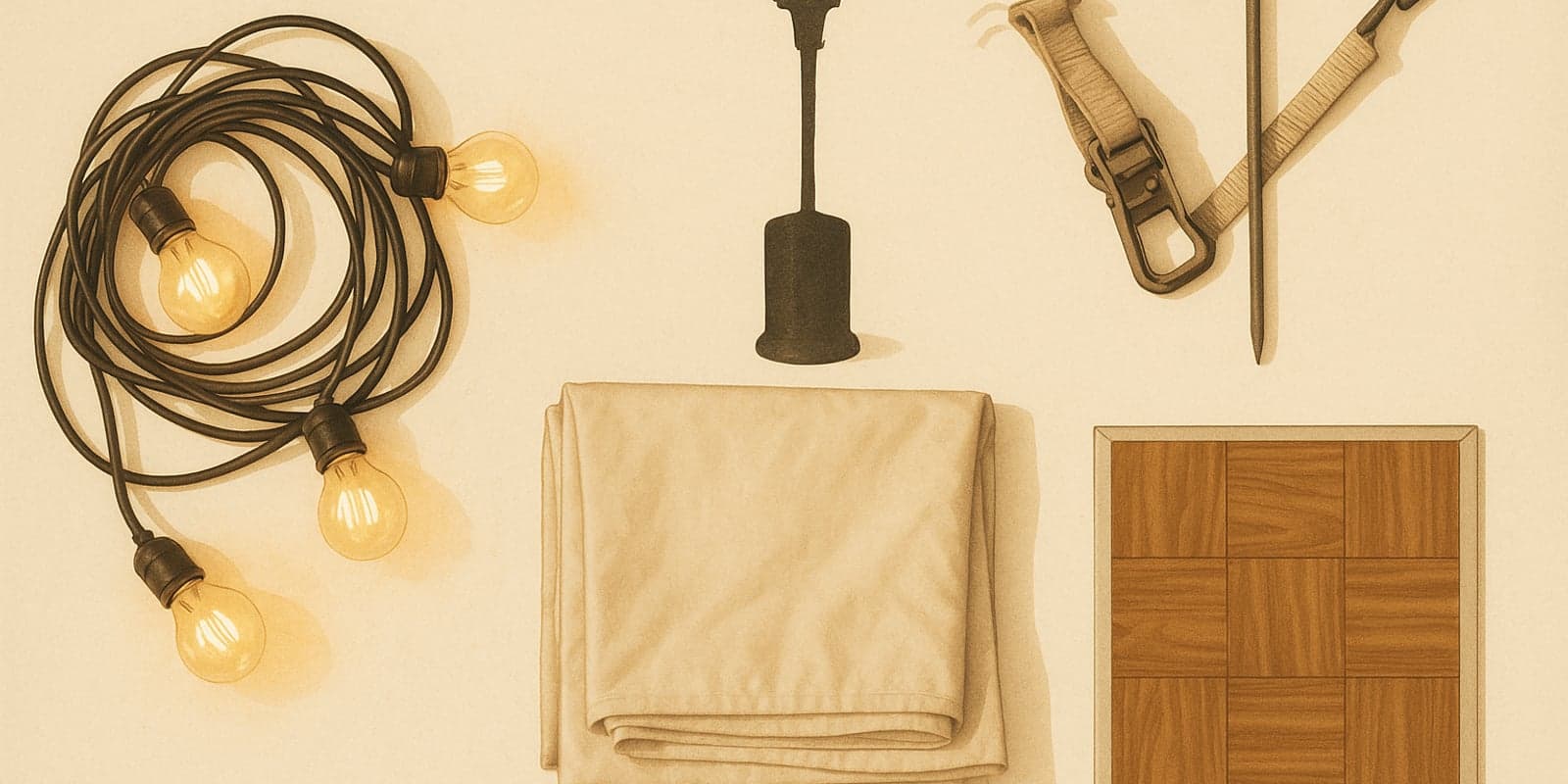
Tent Accessories You Can Buy Yourself
A standard tent rental includes the tent, tables, and chairs, plus basic anchoring. Everything that makes a tent an event space (lighting, heating, cooling, sidewalls, flooring, power) is either an add-on you rent at a markup or something you buy outright. This guide covers what's worth buying yourself, what to leave on the rental invoice, and how to avoid the mistakes I see at most events I walk into.
How this guide is organized
Six categories, ordered by how much impact each makes on a real event. Anchoring and wind protection first because a tent that fails in a storm makes everything else irrelevant. Lighting and climate second because they determine whether guests stay past sunset and whether photographers capture the venue. Flooring, decor, and power are situational. Each section has buying criteria based on actual tent dimensions and wattage math, not marketing copy.
Anchoring & Wind Protection
Your rental company will anchor the tent the way they were taught for their climate, but they aren't responsible for reinforcing it beyond minimum spec. If your event is on grass, stakes work. On pavement, decks, patio, or any hardscape you need weights. A typical 20x20 frame tent needs 4-6 anchor points rated at 400 lb or more each to stay secure in 30 mph gusts, and tents over 40 ft require engineered weight plans in most jurisdictions.
How to choose
- 1.Match the surface: long galvanized stakes (12-24 inch) for grass; concrete or water-fillable weights for pavement. Mixing the two on the same tent is a wind failure waiting to happen.
- 2.Check the wind rating of your tent against local forecast, most rental tents are rated to 35-40 mph sustained. Add ratchet straps if your event is in a coastal or open-plain area.
- 3.Oversize your anchor count, not your anchor weight. Eight 200 lb weights distribute force better than four 400 lb weights on a 20x40 tent.
- 4.If you are hosting in hurricane or tornado season, ask your rental company for an engineered anchor plan rather than their default.
Common mistake
Relying on the rental company's standard setup on pavement without verifying the weight total meets local fire-code minimums. Calling the venue or fire marshal takes 10 minutes and prevents an evacuation.
Recommended products
Heavy-duty 12-inch ground stakes
Galvanized or steel stakes for anchoring frame and pole tents on grass or dirt. Look for at least 5/8 inch diameter for wind ratings above 30 mph.
Concrete tent weight plates
For pavement, decks, or any hardscape where you cannot stake. Standard spec is 400 lb per leg for a 20x20 frame tent. Cheaper than sandbags long-term.
Fillable sandbag weights
Cheaper anchoring alternative. Fill on site and dump after the event. Four 40-lb sandbags hold most 10x10 canopies; step up for larger tents.
Ratchet tie-down straps
Tension straps for pole-tent guylines or reinforcing frame-tent anchoring in high wind. Buy rated for at least 1,000 lb working load.
Lighting
Most rental companies include bare-bulb utility lighting only, enough to see, nothing photogenic. Edison-bulb string lights and battery-powered uplights are the two biggest DIY upgrades for weddings and evening events. A 20x40 tent with 3-4 strands of 48 ft Edison lights plus 6-8 wireless uplights will look like a $2,000 rental-company upgrade for under $400.
How to choose
- 1.For overhead ambiance, use shatterproof outdoor-rated Edison strings with heavy-gauge cords. Cheap indoor strings fail in humidity and fade unevenly.
- 2.For wall-wash color (pink, amber, blue), battery uplights beat plug-in DMX fixtures because you don't need cord runs along the tent perimeter.
- 3.Plan strand count before you buy: 1 strand per 10 ft of tent length as a rule of thumb for a full glow, half that for a subtle look.
- 4.Solar path lights are worth buying for entry walkways, especially if your venue has no dedicated outdoor power near the parking area.
Common mistake
Buying warm-white strings that test at 3000K+. For wedding photography, 2200K-2700K Edison looks dramatically warmer and matches candlelight, verify color temp on the product listing.
Recommended products
Outdoor Edison bulb string lights
Classic warm-white wedding/event lighting. Look for shatterproof bulbs, outdoor-rated cords, and at least 48 ft of length per strand. Chain multiple strands together for larger tents.
Battery-powered wireless uplights
Cordless color-changing spotlights to wash tent interior walls or highlight a cake table. Most last 6-10 hours on a charge, controlled by remote or DMX.
Solar pathway & entry lights
Line the tent entrance or the walkway from parking. Solar means no extension cords, useful for remote venues. Charges during the day, auto-on at dusk.
Climate Control, Heaters & Fans
Tents trap or reject temperature extremes worse than most people expect. On a 90°F afternoon a shaded vinyl-top tent can still hit 100°F+ inside without active airflow. On a 40°F night a sailcloth tent with no heat drops to mid-40s with guests inside. Plan climate budget into your rental, not as an afterthought.
How to choose
- 1.Propane patio heaters, one 40,000 BTU unit covers roughly 100 sq ft of radiant warmth. For a 20x40 tent in 45°F weather, plan 4-6 heaters minimum.
- 2.Misting fans drop effective temperature 15-20°F and cost less than portable AC for tents without sidewalls. Need water hookup or 5+ gallon reservoir.
- 3.Pedestal/industrial fans cost less but only circulate air, they don't reduce temperature. Good under shade, useless in direct sun.
- 4.Portable AC for tents requires sidewalls to retain cool air. If you're buying AC, budget for sidewalls or plan an open-air event.
Common mistake
Underestimating heater count for cold weddings. Two heaters for 80 guests isn't enough, plan one per 20-25 guests standing, or one per 15 sq ft of cold-sensitive zone like the ceremony aisle.
Recommended products
Propane patio heater (40,000 BTU)
Standard pyramid or mushroom-style outdoor heater. Each unit warms roughly 100 sq ft. Plan for 4-6 heaters under a 20x40 tent for cold-weather events.
High-velocity outdoor misting fan
For summer events. A single 30-inch misting fan cools a 20x20 tent by dropping effective temperature 15-20 degrees. Needs water hookup or reservoir.
Pedestal / pole fan (heavy duty)
Non-misting circulation fan for shaded tents. 20-inch industrial fans move 5,000+ CFM. Cheaper than misters and needs only power, not water.
Flooring & Dance Floors
Snap-together plastic tiles protect grass, give a hard surface for chairs, bars, and dance floors, and cost roughly a third of what rental flooring costs for events under 400 sq ft. For larger dance floors, rental is usually cheaper because installation labor is built in.
How to choose
- 1.Dance floor size: 15x15 (225 sq ft) handles 50-80 dancers; 20x20 (400 sq ft) handles 80-120. See our tent size calculator for math.
- 2.Grass protection tiles are different from dance floor tiles, they're mesh, not solid, and let grass recover. Use them under chair legs, bar stations, and walkways.
- 3.If your event is on a slope, a full subfloor is required, don't try to lay tiles directly. The tilt makes standing uncomfortable and tables wobble.
- 4.For rain plans, tiles beat flat tarps every time because water drains between tiles instead of pooling on top.
Common mistake
Buying enough dance floor tiles for the advertised dance floor size but forgetting the 2-3 ft perimeter of chairs and standing guests. Your 15x15 dance floor actually needs a 20x20 tile footprint to accommodate the cluster around it.
Recommended products
Interlocking dance floor tiles
Snap-together plastic tiles (usually 12x12 inch). Install in 15 minutes. Most weddings need a 12x12 or 15x15 dance floor for 50-80 guests.
Grass protection mesh tiles
Lay under chairs, bars, or high-traffic zones to avoid trenching the lawn. Popular for backyard weddings where grass recovery matters.
Sidewalls, Draping & Decor
Sidewalls are often a per-wall rental charge ($75-200 each), four walls on a 20x40 tent can add $500 to your rental invoice. Buying outright pays off in 1-2 events for repeat users. Clear vinyl preserves the outdoor view and is what luxury weddings use; solid white sidewalls give maximum privacy and sound control.
How to choose
- 1.Clear vinyl for weddings and photo-driven events; solid white for corporate events, construction sites, and anywhere you want to block line-of-sight.
- 2.Sidewall height must match your tent, standard is 8 ft for frame tents. Do not buy short sidewalls thinking you'll raise them.
- 3.Pipe-and-drape kits replicate ceremony backdrops, photo-booth backgrounds, and vendor dividers. Adjustable-height kits handle any tent.
- 4.Tent ceiling liners (swag drapes) are the single biggest upgrade to a frame tent's appearance. They hide exposed metal supports and transform rental-grade tents into venue-grade.
Common mistake
Ordering sidewalls without checking whether the rental company will let you install them yourself. Some rental contracts require their crew for anything attached to their tent, ask before you buy.
Recommended products
Clear vinyl tent sidewalls
Transparent sidewalls keep wind and rain out while preserving outdoor views. Most rental companies charge $100-200 per sidewall, a one-time purchase often pays off in 1-2 events.
Pipe and drape backdrop kit
Adjustable pipe frame with fabric drape. Use for ceremony backdrops, photo booths, or dividing larger tent interiors into sections.
Tent ceiling drape / liner
Hanging fabric liner to hide the tent's metal structure. Drastically upgrades the look of a standard frame tent, the difference between rental-tent and luxury-tent aesthetics.
Power & Generators
Remote venues (farms, parks, backyards with no outdoor outlets, private estates far from the house) usually lack outdoor power where you need it. A 2,000-3,500W inverter generator handles string lights plus a sound system; heavy loads like electric heaters, commercial coolers, or portable AC need 7,500W+ conventional or inverter generators.
How to choose
- 1.Inverter generators run 20-40 dB quieter than contractor generators, critical for weddings and any event with speeches or ceremonies.
- 2.Add up peak watts: each propane heater ignition draws 200W startup, each misting fan 500W continuous, string lights 50-100W per strand, DJ system 500-1500W.
- 3.Always oversize. Running a generator at 90% load sustained burns it out faster and is louder than running at 50%.
- 4.12-gauge outdoor extension cords only. Cheaper thinner cords drop voltage over 50+ ft and cause string lights to flicker or fail.
Common mistake
Underestimating generator size because the nameplate wattage of each device is misleading. Always use startup wattage, not running wattage, when sizing.
Recommended products
2,000W inverter generator (quiet)
Powers string lights, sound system, and lighter equipment. Inverter generators run much quieter than contractor generators, important for weddings and ceremonies.
7,500W inverter generator
Large enough for heaters, portable AC, full sound, and full bar equipment. Needed for cold-weather tented events without hardwired venue power.
Heavy-duty 100 ft outdoor extension cords
12-gauge, outdoor-rated cords to get power from the venue to the tent. Always size up, undersized cords cause voltage drop that burns out lighting.
Still need the tent itself?
Find a local rental company by city. Most include setup, takedown, tables, and chairs in their base pricing, these accessories fill in the gaps.
As an Amazon Associate, Tent Rentals Directory earns from qualifying purchases. Product links on this page may be affiliate links, we may earn a small commission when you purchase through them, at no additional cost to you. Prices and availability are accurate at the time we curate products but may change on Amazon.