
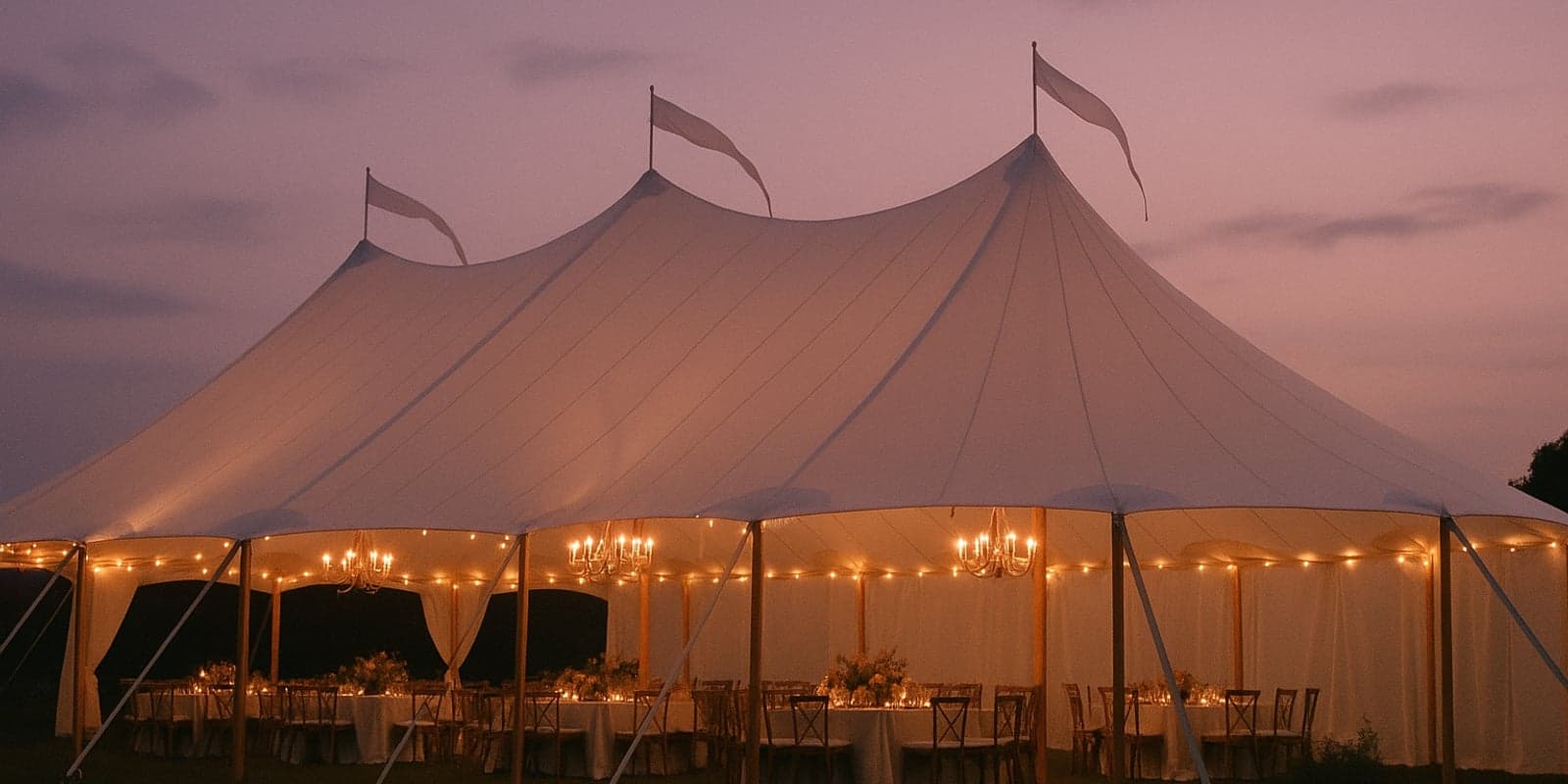
Sailcloth is the tent you recognize from every luxury-wedding magazine cover of the last ten years. Translucent cotton-poly fabric stretched over wooden center poles, held up with tensioned guylines. During the day it filters sunlight softly; at night, interior lighting turns the whole tent into a glowing sculpture. That glow is the entire reason sailcloth commands a premium, and the entire reason inventory sells out 12-18 months ahead in top wedding markets.
What makes a sailcloth tent different
Three things distinguish sailcloth from a standard pole or frame tent:
- Fabric translucency.Vinyl tent tops are opaque. Sailcloth tops are semi-translucent, roughly like looking through rice paper. That's what enables the night-glow effect.
- Wooden poles and wood-tone interior details. Traditional sailcloth uses natural-finish wood poles (ash, douglas fir, or white pine) instead of metal. The warmer, more organic aesthetic fits farm weddings, estate weddings, and rustic-upscale venues.
- Handcrafted feel.Seams, edging, and installed lighting all look more refined than a vinyl frame tent. This matters for photography and for the overall sense of "custom" vs. "rental."
Common sailcloth tent sizes
Sailcloth sizing is different from frame tents. Rather than square multiples of 20 ft, sailcloth uses fixed widths (usually 32, 44, or later 59 ft) with variable lengths determined by how many middle sections the company stocks.
| Size | Square feet | Seated capacity | Typical use |
|---|---|---|---|
| 32x33 (Sperry) | 1,056 | 70-80 | Intimate weddings, 60-80 guests |
| 44x44 | 1,936 | 130-150 | Medium weddings, dinner + dance floor |
| 44x63 | 2,772 | 180-220 | Larger weddings, full reception |
| 44x83 | 3,652 | 240-290 | Large weddings, 250+ guests |
| 44x103 | 4,532 | 300-360 | Multi-section events, estates |
For exact sizing based on guest count and reception layout, our tent size calculatoruses the same per-guest math regardless of tent type. The main sailcloth caveat: rentals don't slice finely, if the 44x63 is booked, you usually have to jump to 44x83 rather than upsize by a few feet.
What sailcloth actually costs
Sailcloth typically runs 60-120% more than a comparable frame tent. For context, a 44x83 sailcloth (~3,600 sq ft, seats ~250) commonly rents for $8,000-$14,000 for just the tent. A 40x80 frame tent at similar square footage rents for $2,800-$5,500 for the bare tent. That's the premium in dollar terms.
Full sailcloth packages, tent plus sidewalls, perimeter lighting, chandeliers, sailcloth-matched liners, flooring, generators, and setup , commonly land $15,000-$35,000 for 150-250 guest weddings. Luxury destination events (Nantucket, Napa, Hamptons) can climb past $50,000.
See our full wedding tent rental cost guide for line-item breakdowns that apply to sailcloth as well as frame and pole tents.
Availability is the actual bottleneck
Sailcloth inventory is concentrated in a handful of markets. The major ones:
- New England coast:Newport RI, Cape Cod, Nantucket, Martha's Vineyard, Boston suburbs
- Hudson Valley and Hamptons: Long Island East End, Catskills, Berkshires
- Wine country: Napa, Sonoma, Willamette Valley, Texas Hill Country
- Southeast: Charleston SC, Savannah GA, coastal North Carolina
- Mountain West: Aspen CO, Jackson WY, Park City UT, Santa Fe NM
- Southern California: Santa Barbara, Ojai, Carmel
Outside these markets, sailcloth often means shipping a tent from 200+ miles away, which adds $1,500-$5,000 in delivery alone. Some destination couples fly in a specific sailcloth rental company for multi-state events, this is common in the very top tier of the market.
Before you commit to sailcloth
Five practical questions to answer before signing a contract:
- Is your venue surface grass or dirt? Sailcloth is a pole tent. It cannot go on pavement or hardscape.
- Is your event date a peak Saturday? If yes, expect to book 12-18 months ahead. If no, you have more flexibility.
- Does your budget allow for sailcloth lighting too? Bistro strings alone under-deliver the glow aesthetic. You want perimeter uplighting or chandeliers plus strings, budget an extra $1,500-$4,000.
- Have you confirmed rain plan logistics?Sailcloth rain plans are more restrictive than frame, some companies won't set up if sustained rain is forecast. Clarify the cancellation and reschedule policy in writing.
- Do you have event insurance? Rental contracts for sailcloth commonly require higher coverage limits ($2M/$3M vs. the standard $1M/$2M for frame tents). See our event insurance guide.
Frequently asked questions
What is a sailcloth tent?▾
A sailcloth tent is a premium event tent that uses semi-translucent cotton-polyester fabric on a wooden pole structure. During the day, sunlight filters through softly; at night, interior lighting makes the entire tent glow, which is the aesthetic that made sailcloth the default luxury wedding tent over the last 15 years. The Sperry Tents brand pioneered the modern sailcloth look in the early 2000s.
How much does a sailcloth tent rental cost?▾
Sailcloth tents typically cost 60-120% more than a comparable frame tent, expect $4,000-$15,000 for the tent alone on a wedding-scale event. A 44x83 sailcloth (~250 guests) runs $8,000-$14,000 for the tent, plus sidewalls ($150-$300 each), lighting packages ($1,000-$4,000), and flooring. Full sailcloth reception packages for 150-250 guests commonly land $15,000-$35,000 all-in.
Why are sailcloth tents so expensive?▾
Three reasons: the fabric itself is specialty-woven cotton-poly, not commodity vinyl; the wooden pole systems are hand-finished and heavier to handle, requiring larger setup crews (6-10 people vs. 3-5 for frame tents); and inventory is scarce, most markets have only 1-3 rental companies carrying sailcloth, so there's no price competition. Replacement cost for a new 44x83 sailcloth tent runs $60,000-$100,000.
Are sailcloth tents available in every city?▾
No. Sailcloth inventory is concentrated in high-end wedding markets: Newport RI, Cape Cod, Nantucket, the Hamptons, Napa Valley, Sonoma, Charleston, Santa Barbara, Santa Fe, and parts of Colorado and Texas. Most metros have either zero sailcloth rental companies or one with very limited inventory. Expect to book 12-18 months ahead for prime season in major wedding markets.
Sailcloth tent vs. frame tent, which should I pick?▾
Sailcloth wins on aesthetics, the glow at night is unmatched and photographs beautifully. Frame tents win on versatility, availability, and price. If your venue is a refined estate or farm with good views, and photography matters, sailcloth. If your venue is urban, the event is corporate, or budget is tight, frame. A mid-range compromise: sailcloth-look polyester replicas from some rental companies at 20-40% below true sailcloth prices.
What surface does a sailcloth tent need?▾
Sailcloth tents are pole tents, which means they must be staked into grass or dirt. They cannot be set up on pavement, decks, or any hardscape. Some coastal markets (Cape Cod, Nantucket) use specialized sand-stake systems for beach events, but this requires an experienced crew and permit coordination with local beach authorities. If your venue is paved, sailcloth is off the table, look at frame or pole tents instead.
How far in advance should I book a sailcloth tent?▾
For peak-season Saturdays (June, September, October) in top wedding markets, book 12-18 months out. For off-peak dates or secondary markets, 6-9 months is usually enough. Inventory is the bottleneck, a single 44x63 sailcloth tent in Newport or Napa is often booked out 15+ months ahead because the rental company only owns 2-3 of them.
Can sailcloth tents handle rain or wind?▾
Yes, within limits. Modern sailcloth fabric is treated with a water-repellent coating and handles typical rain fine. Sustained heavy rain can eventually soak through; most high-end companies include a rain-plan protocol. Wind rating is similar to other pole tents, 35-40 mph sustained before the crew de-tensions. For hurricane or severe weather forecasts, expect the company to take the tent down preemptively, which is why rain-or-postpone insurance matters more with sailcloth than with frame tents.